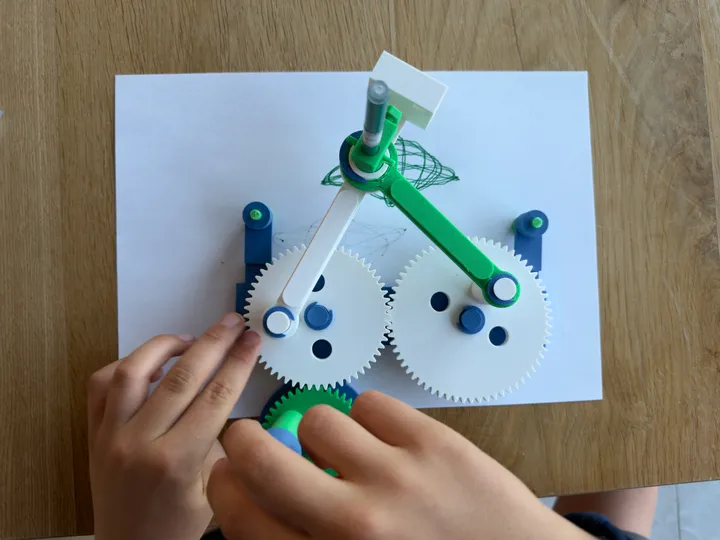
I asked GPT-6 Astra to design a cycloid drawing machine I could 3D print: turn a crank and gears move a pen through fun geometric patterns. It took two iterations. The first was a tad wonky: it looked convincing on the surface, but the mechanism couldn't really work. For the second, I asked ChatGPT to first validate the design through simulation, with a hand turning the crank and enough room for it throughout the motion (it also created a reusable skill for this; the design checks used MuJoCo for motion simulation and Coal for collision and clearance checks). I printed it, assembled it, and it actually worked. It even provided interchangeable gears so I could draw different geometric patterns. That's the thing in the photos, drawing on paper.
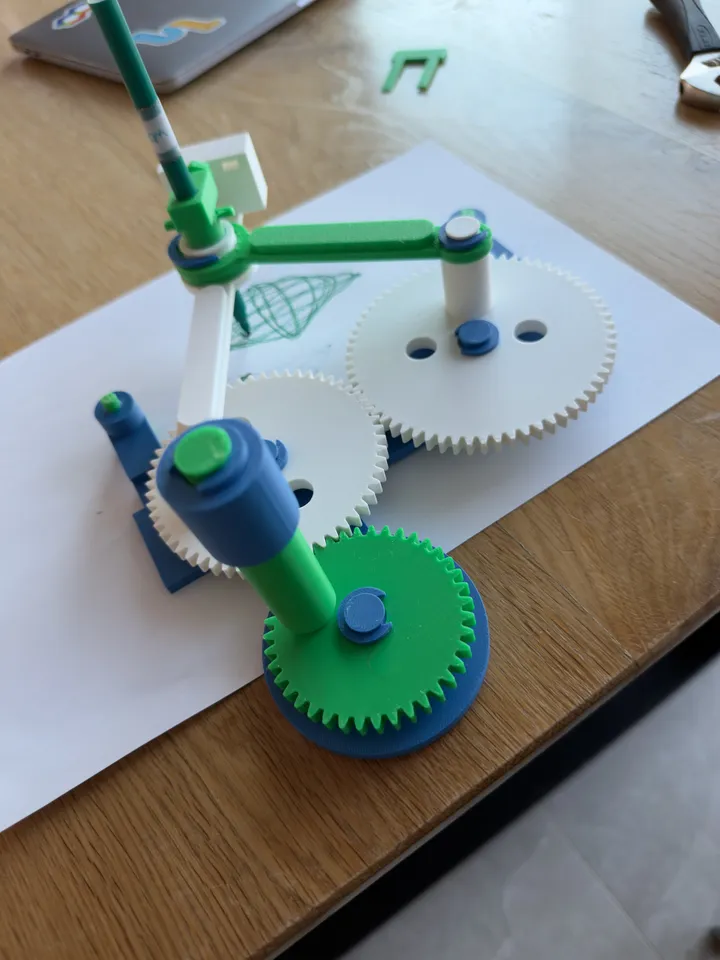
I'm still amazed by how little effort this took. That amazement has mostly worn off for me when it comes to software development; directing models to build things is just how I work now. But not that long ago I was modelling parts in Fusion 360, thinking it would be a while before I could spend most of my time orchestrating models for physical things too. And now there's a little machine on my table that ChatGPT designed, turning a crank into drawings. Kind of crazy.